
Galen (129-200)

Galen as experimenter
In ancient history the Greek physician Galen (c. 129-c. 200) was the first to show that veins were connected to the heart and that arteries contained blood. Galen was an experimenter performing animal dissections and thoroughly describing anatomical details. The interpretation of his findings remained within the Greek tradition going back to Hippocrates and Aristotle.
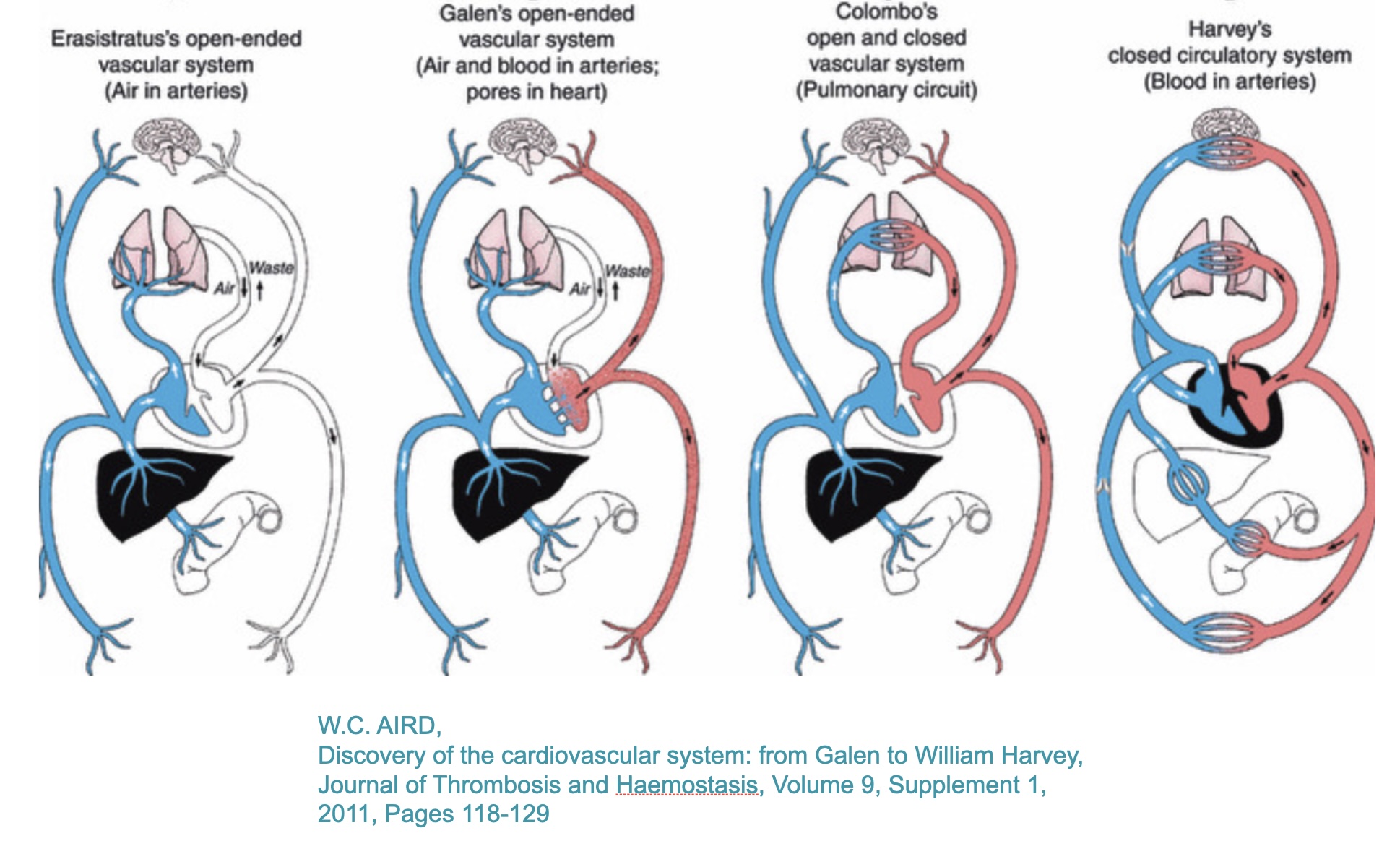
He regarded blood to be produced in the liver where it received its "natural spirit" and from which it flowed out to the periphery of the body due to a pulling or attractive force. Transported to the heart, the blood obtained "vital spirits" moved from the right to left side of the heart (Galen supposed both halfs were separated by a permeable membrane) and finally received its "animal spirits" from the brain.
Galen embraced by the Church
Galen's medical authority lasted for almost 1500 years. His writings on human physiology, anatomy, the use of medication etc. were embraced by the church and achieved dogmatic status. It was hard for his successors to propose new ideas on the physiology of blood and blood flow.
Harvey (1578-1657)

In 1628, after 20 years of experimenting, William Harvey (1578-1657) finally felt confident enough to publish 'De motu cordis'. In this book Harvey described how the blood circulates through the body: that the blood travels through arteries to the different organs and returns to the heart via veins. Although at that stage he was unable to see them himself he postulated that the blood passes through tiny capillaries allowing the transition from arterial to venous phase. Also, he described the small circulation from heart to lungs and back. He realised that the small and large circulation are separated only by the heart septum which therefore cannot be permeable to blood.
Young (1773-1829)
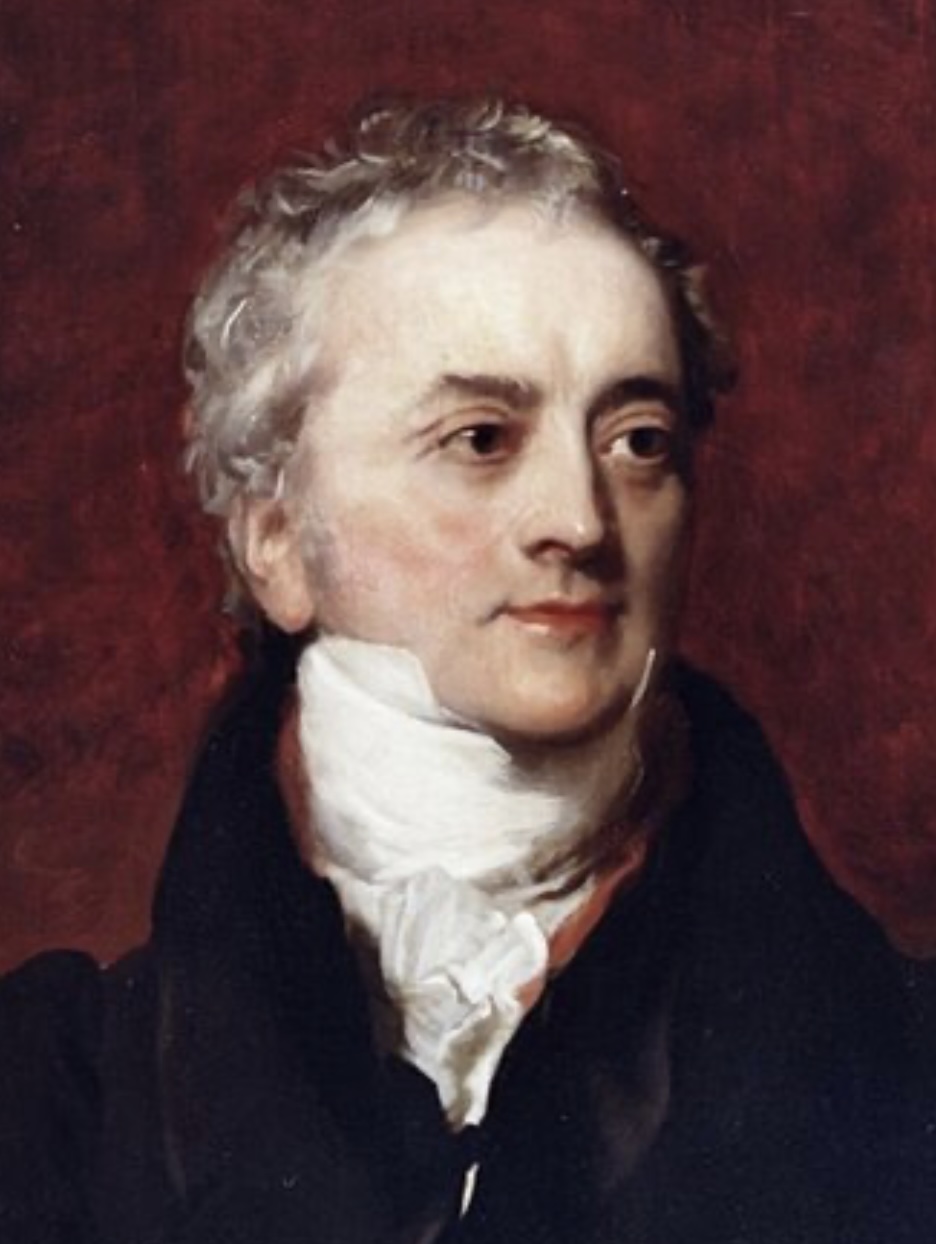
Thomas Young was a man of many talents. In his Croonian lecture ("Functions of the Heart and Arteries", 1808) he reported on experiments with tubes of variable length and diameter. He discovered that tubes with a smaller diameter were more resistant to flow than tubes that were wider. Since the diameter of arteries becomes smaller at every junction of the arterial tree, their resistance becomes higher.

This argument, however, only holds for individual arteries and ignores the effect of their exponential increase in numbers: a replacement resistance would be smaller than the sum of the arteriolar resistances since they stand in parallel, not in series. The ever decreasing diameter of conducting arteries in the arterial tree was also erroneously taken as explanation for the often observed increase in pulse wave velocity towards periphery, again ignoring the exponential increase in numbers.
Frank (1865-1944)

The name of Otto Frank is strongly linked to the Frank-Starling law of the heart, but also to the Windkessel model of the arterial system. Frank envisaged how the aorta by its elastic properties could temporarily store the volume ejected by the heart to release its content during diastole. He devised a 2-element windkessel model depicted below to explain the characteristics of the arterial blood pressure wave. His ideas were most likely based upon the work of Stephen Hales, who wrote a book called Haemostatics in 1733.

Possibly the first to describe waveforms as a combination of forward and backward traveling waves were the brothers W.E. and E.H. Wever in a monograph called Wellenlehre (1825).
McDonald (1917-1973)

Donald A McDonald, the well known author of "Blood flow in arteries" (1960), went on to explain the characteristic waveform of the arterial pressure pulse from forward and backward traveling waves. He found that while the pressure pulse is increasing in size the amplitude of the flow pulse is decreasing. This was modeled as a wave traveling in a tube with a partially closed end. The resulting high resistance to outflow would cause reflecting waves traveling back in the direction of its origin and causing complex interference at any point of measurement along its trajectory.

Schaafsma (1962-..)
After performing many simultaneous transcranial Doppler (TCD) and arterial blood pressure (ABP) investigations in patients with carotid stenosis as well as patients undergoing autonomic function tests, Schaafsma came to the conclusion that the systolic waveform consists of two distinct phases that vary independently: a Sys1 thought to arise from a short-lasting contraction in the smooth muscle cells within the conducting arteries, followed by a Sys2 that related to stroke volume and peripheral resistance. For instance, during deep breathing (5 seconds of deep inhalation followed by 5 seconds of exhalation repeated 8-10 times) the variability of Sys2 was considerably larger than of Sys1.

The theory of arterial acceleration was first published in Medical Hypotheses in 2014 but for long received only little attention. It was followed by an observation of blood flow velocity recordings in patients with aortic stenosis in 2026 showing that the turbulent flow measured directly behind the stenotic aortic valve (Sys2) became increasingly preceded and overtaken by a wave with laminar flow (Sys1) at proximal to distal measurement sites. This study provided strong evidence that the conducting arteries add energy to the pressure wave from the heart.
